Digital Twins for Product Testing: Complete Guide to AI-Powered Market Research
TL;DR: Digital twins revolutionize product testing by allowing you to test products, features, and concepts with virtual consumers in hours instead of weeks, reducing costs by 90% and eliminating launch risks.
Why Traditional Product Testing Is Broken
Product managers face an impossible paradox: markets demand faster innovation while traditional testing methods get slower and more expensive.
The numbers tell the story. Traditional product testing takes 8-12 weeks from concept to insights, while competitors launch new features monthly. A basic concept validation study costs €15,000-50,000, making continuous testing financially impossible for most companies.
Meanwhile, recruitment challenges multiply. Need feedback from "enterprise CTOs who use cloud infrastructure"? Expect 4-6 weeks just to find 20 qualified participants. Want to test across multiple markets? Add another month and double the budget.
The result? Most companies test once per quarter at best, making critical product decisions based on outdated insights or pure intuition. In fast-moving markets, this approach guarantees you'll be behind before you launch.
How Digital Twins Transform Product Testing
Digital twins are transforming how product teams validate ideas and make decisions. While most content focuses on general market research applications, understanding how digital twins work is crucial for product teams looking to gain a competitive edge.
Digital twins represent a shift from reactive testing to proactive product intelligence. Instead of asking "Will customers like this?" After months of development, you continuously ask "What do customers want?" throughout the entire product process.
The Game-Changing Benefits
Fast and Iterative Testing
Traditional product testing locks you into 8-12 week cycles that kill innovation speed. Digital twins enable rapid testing loops, test a concept Monday morning, get insights by lunch.
Massive Cost Reduction
Traditional product testing costs €15,000-50,000 per study. Digital twins reduce this to €500-2,000 - a 90-95% cost reduction that transforms research from an occasional luxury into an always-on capability. This dramatic cost reduction is particularly game-changing for small businesses, democratizing access to professional market research that was previously reserved for large corporations.
Strategic Decision Support
Digital twins excel at "what if" scenario planning, letting you model complex business scenarios before committing resources.
Product Testing Use Cases with Digital Twins
Concept Validation
The earliest and most critical stage of product development. Instead of betting on one idea, digital twins let you test multiple concepts simultaneously and identify winners before any development investment.
Example: A fitness app startup tests 3 different app concepts - workout tracking, meal planning, and habit building - with 500 potential users in 2 hours, discovering that habit building shows 80% more interest than the other options.
Key applications:
- New product ideas validation across target segments
- Feature prioritization based on customer demand
- Value proposition testing and refinement
- Market gap identification and opportunity sizing
Design & UX Testing
Visual and interaction design significantly impact product success, but traditional usability testing is slow and expensive. Digital twins accelerate this process while providing deeper insights across user types.
Example: An online store tests 2 different homepage designs - one with large product images, one with customer reviews prominent - and finds that the review-focused design increases purchase intent by 35% among first-time visitors.
What you can test:
- Package design appeal across demographics and regions
- UI/UX flow preferences by user type and experience level
- Visual hierarchy effectiveness and brand perception impact
- Navigation patterns and conversion optimization
Pricing Strategy
Beyond simple price points, digital twins enable sophisticated pricing strategy validation that balances customer willingness to pay with business objectives.
Example: A meal delivery service tests 4 pricing options - €8, €12, €15, and €18 per meal - discovering that €12 generates the highest overall revenue despite €15 having better margins, because adoption drops significantly at the higher price.
Advanced pricing research:
- Price sensitivity curves by customer segment
- Bundle vs. individual feature pricing effectiveness
- Premium positioning validation and price anchoring
- Competitive price response modeling and market dynamics
Market Fit Assessment
Understanding not just if customers want your product, but which specific customers want it most, why they want it, and how to reach them effectively.
Digital twins help you:
- Validate and refine target audience definitions
- Analyze competitive positioning and differentiation opportunities
- Rank feature importance by customer segment
- Identify primary purchase drivers and decision-making factors
- Map customer journey touchpoints and conversion barriers
This comprehensive approach ensures you're building the right product for the right customers at the right price before you invest significant resources in development and launch.
Real-World Product Testing Example
How We Validated a New Superfood Bar Concept with Digital Twins
In consumer goods, validating a new product before creating it is crucial. What if we could do this quickly and easily, right from our desk?
With Digital Twins, we tested an innovative approach: simulating the launch of a new superfood bar line with ingredients like spirulina, goji berries, matcha, and turmeric. Our goal was simple: understand health-conscious Italian consumers to test a concept still in development.
Creating the Panel
Software platforms like DTwin allow you to identify and build target audiences starting from a simple description. The AI engine leverages vast datasets to first intercept relevant consumer data, then generate realistic Digital Twins that match your specifications. Digital twins technology combines multiple data sources and AI modeling techniques to create these synthetic but realistic consumer profiles.
We built our synthetic panel through Digital Twins using this description:
"Health-conscious Italian consumers who choose foods based on nutrition, read labels carefully, and prefer natural ingredients like superfoods. They look for functional snacks to support health, wellness, and sports activities."
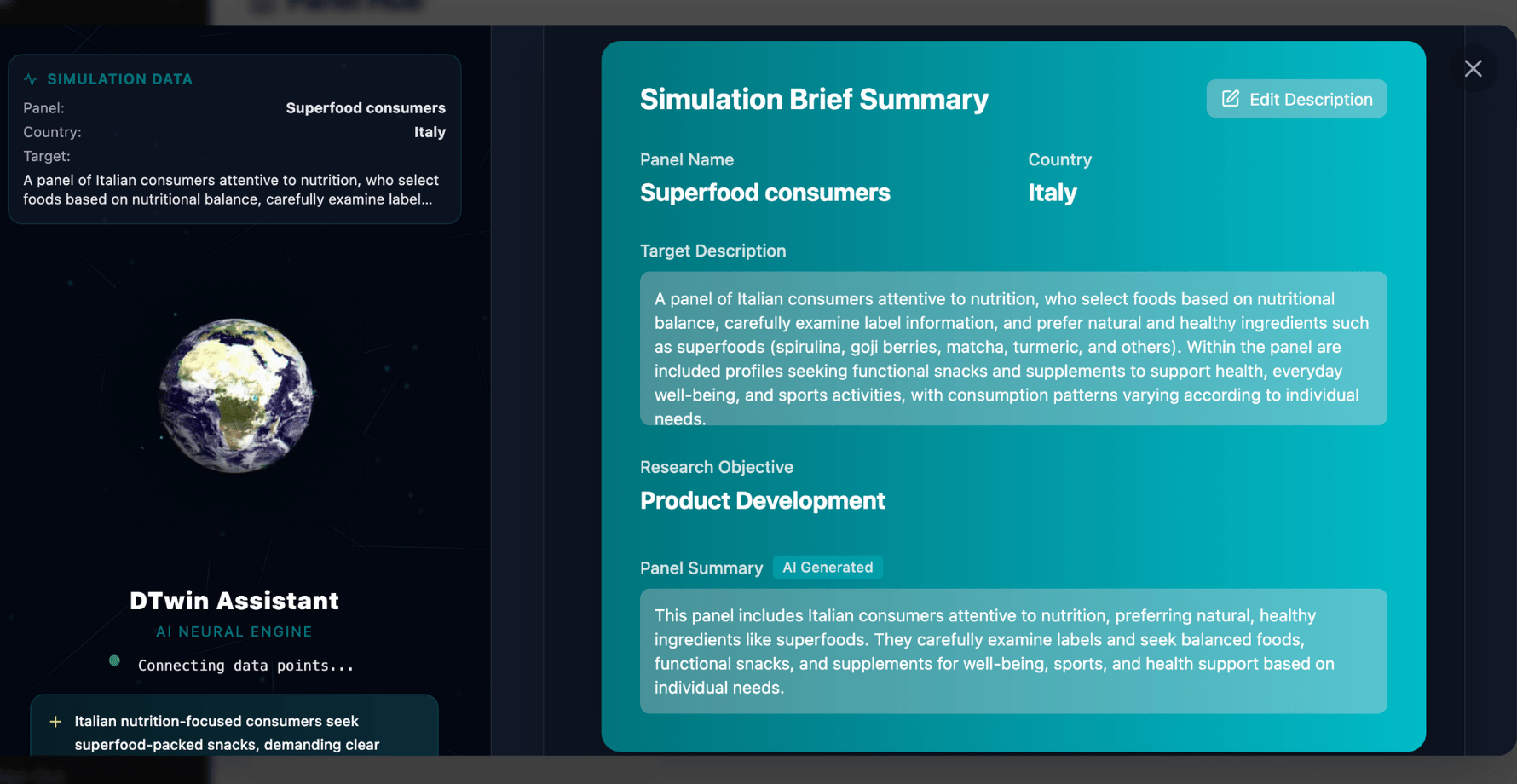
In minutes, the platform generated hundreds of Digital Twins representing Italian consumers focused on nutrition, natural ingredients, and daily wellness. These aren't random data points - they're realistic profiles built on demographic and behavioral patterns that reflect real market complexity.
AI Consumer Segmentation
Digital Twins platforms are able to identify distinct consumer groups via AI-powered segmentation algorithms. In our case, the system identified six groups, including two key segments: "Athletic Performance Optimizers" and "Natural Purists". The first group focuses on sports performance and efficiency, while the second values naturalness and simplicity.
The analysis revealed that "Holistic Wellness Enthusiasts" formed the largest segment (62.6%), followed by "Natural Purists" (13.6%) and "Functional Snack Seekers" (12%). Smaller but highly specific segments included "Athletic Performance Optimizers," "Label-Critical Moderates," and "Functional Supplement Integrators."
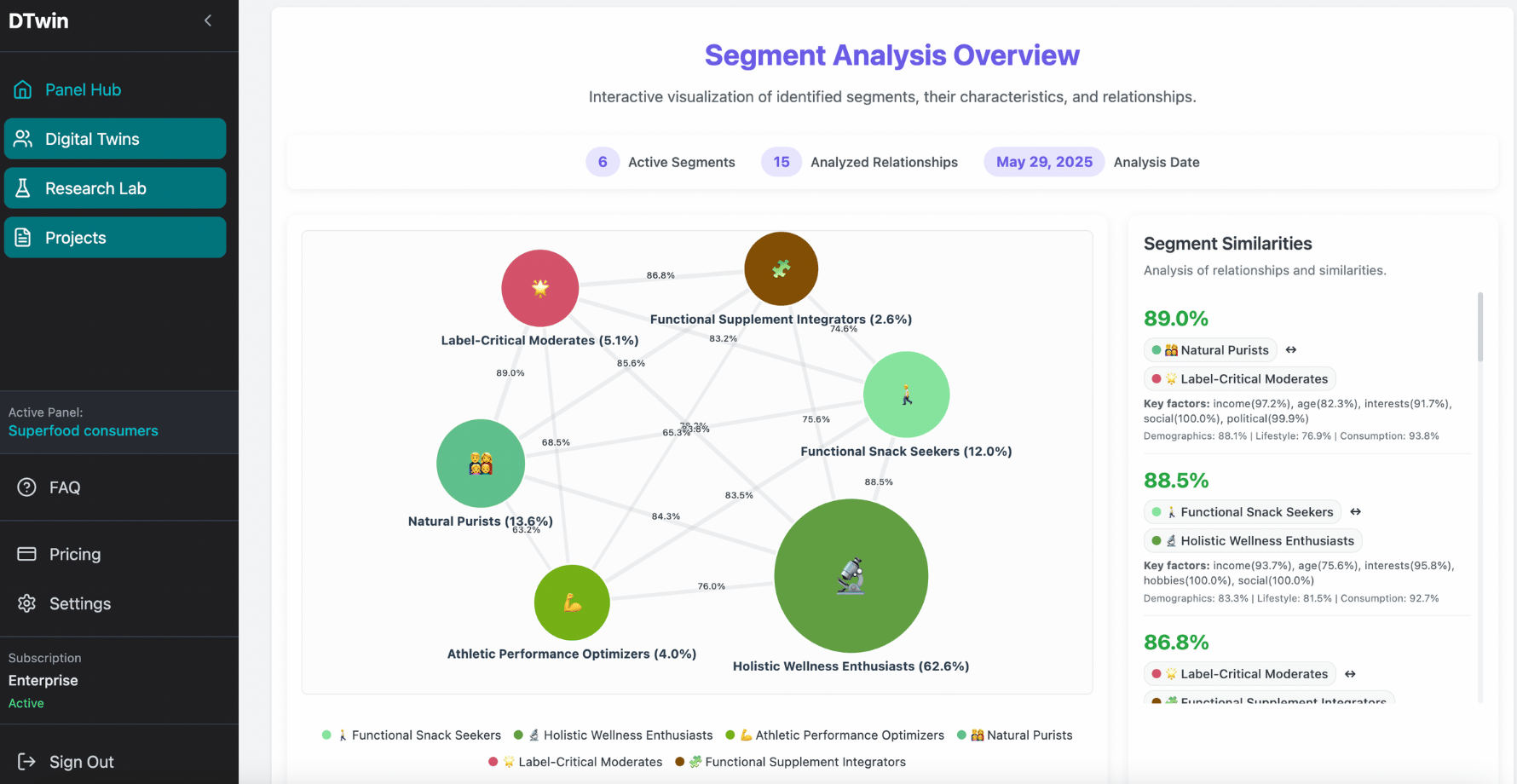
This automated segmentation helped us select the right Digital Twin profiles for high-impact insights and precise testing.
AI Personas in Action
DTwin allows you to transform the identified clusters into conversational AI Personas. This created the Athletic Performer and the Natural Purist: two realistic profiles with stories, faces, values, and needs. We interviewed both, simulating a conversation between opposite viewpoints - the athlete seeking energy boosts versus the purist wanting to know everything about ingredient origins.
An interesting detail? Both showed openness to our bar concept, but for very different reasons. This confirmed the concept had potential, but needed careful positioning for each segment. To discover more about how DTwin's AI Personas work, visit our guide.
Interview Insights: Key Questions We Asked
To dive deeper into perceptions, we asked our Digital Twins targeted questions:
- What do you mainly look for in a snack?
- Do you know spirulina?
- What would make you interested in a product containing spirulina algae?
- What about goji berries?
- Do you like energy bars?
- Would you try a bar with goji berries and spirulina? It would also have cereals, honey, seeds, and dried fruit.
These questions helped us explore awareness, attractiveness, and potential choice drivers for each ingredient, completing the picture from our qualitative research phase.
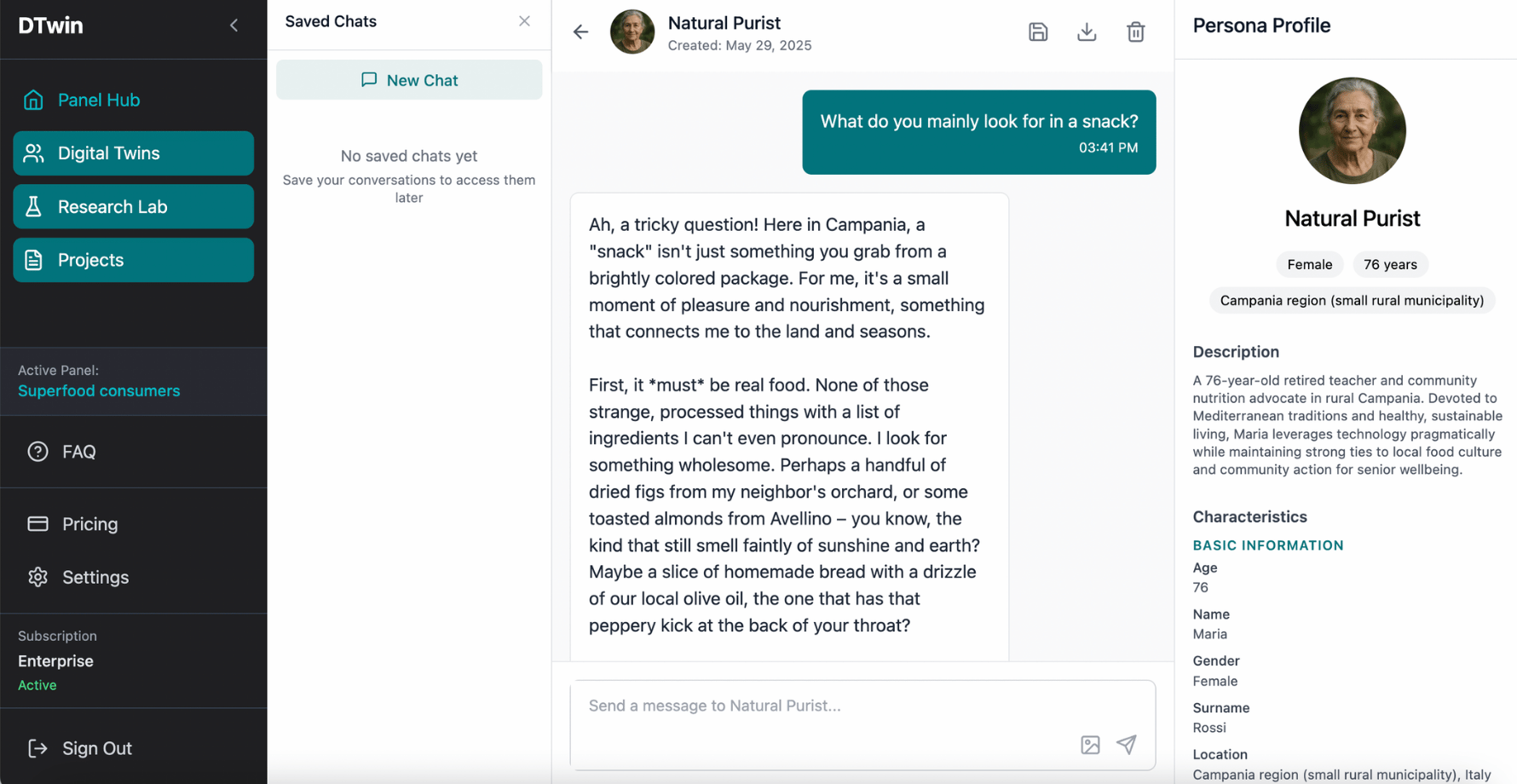
Interviewing personas allows you to understand how different market segments react differently to questions and visual stimuli. This is particularly useful for product teams because it reveals segment-specific preferences, language patterns, and decision triggers that can inform everything from feature development to marketing messaging and visual design choices.
Synthetic Survey to Validate Real Interest
After exploring the market through segmentation and interviews, we tested our idea with a quantitative survey. Want to know more about synthetic surveys? Visit our guide.
With DTwin, we designed a custom survey with conditional logic and branching questions. We used 8 different question types, from open-ended responses to star ratings and comparative matrices, keeping a conversational tone while collecting precise data.
Key questions included:
- What's your favorite healthy snack and why? (open-ended)
- How interesting is a spirulina and goji berry snack? (rating)
- Which superfoods do you know or consume? (multiple choice)
- How much do you agree: "Integrating superfoods is a priority"? (scale)
- How interested are you in these bar variants? (comparison)

Survey Insights: How DTwin Delivers Results
DTwin provides multiple layers of analysis from a single survey. We received raw survey data for detailed analysis, qualitative summaries that highlighted key themes and patterns, and interactive dashboards that let us explore results by segment, question type, and demographic filters.
For example, we discovered that 82.77% preferred individually wrapped bars over grab-and-go format, but when we filtered by age groups, the 25-35 segment showed even stronger preference (91%) due to "portion control and gym convenience."
The survey revealed not only confirmatory patterns, but also friction signals - price sensitivity emerged at €4.50+ per bar, and certain ingredient combinations (spirulina + chocolate) generated skepticism. It was time to dive deeper with focus groups. You can try DTwin for free to discover how synthetic market research works.
From Concept to Confidence in Hours, Not Months
This superfood bar validation project demonstrates the transformative power of digital twins for product testing. In just a few hours, we moved from a rough concept to validated insights that would traditionally require 8-12 weeks and €25,000+ in research costs.
What We Accomplished:
- Identified our best target segment (Holistic Wellness Enthusiasts) through AI-powered segmentation
- Validated core concept appeal across different consumer personas through conversational interviews
- Optimized product positioning with data-driven insights on packaging, pricing, and messaging
- Discovered friction points before any development investment
The Traditional Alternative: Recruiting health-conscious consumers across Italy, coordinating focus groups, conducting surveys, and analyzing results would have taken months and cost tens of thousands of euros, with no guarantee of reaching niche segments like our "Athletic Performance Optimizers."
The Digital Twin Advantage: We tested multiple hypotheses simultaneously, explored consumer psychology in depth, and validated business assumptions with confidence intervals - all from our desk, in real-time. It's a fundamental shift toward continuous product intelligence that matches the speed of modern product development. To explore all digital twins applications beyond product testing, see our comprehensive market research guide.
Ready to validate your next product concept? Start your digital twin journey and transform weeks of uncertainty into hours of actionable insights.
Get started with DTwin's free trial →
FAQ: Digital Twins for Product Testing
What are digital twins in product testing?
Digital twins are AI-powered virtual representations of your target customers that can test products, features, and concepts before you build them. They simulate real consumer behaviors and decision-making processes, allowing you to validate ideas in hours instead of weeks.
How accurate are digital twin product tests compared to traditional research?
Digital twin accuracy typically ranges around 86% compared to traditional research methods.
Can I test physical products with digital twins?
Yes, you can test physical product concepts, packaging designs, and even product experiences through visual stimuli and detailed descriptions. Digital twins are particularly effective for early-stage concept validation before creating physical prototypes.
How long does it take to run a product test with digital twins?
Most product tests can be completed in 2-4 hours from setup to results. Complex multi-scenario testing might take up to a day, compared to 8-12 weeks for traditional product testing methods.
What's the cost difference between digital twin and traditional product testing?
Digital twin product testing typically costs €500-2,000 per study, compared to €15,000-50,000 for traditional methods - a 90-95% cost reduction that makes continuous testing financially viable.
What types of products work best with digital twin testing?
Digital twins excel with consumer goods, software features, service concepts, and digital products. They're particularly effective for testing multiple variations, pricing strategies, and target audience validation across any industry.
How do I know which customer segments to test with digital twins?
Digital twin platforms can automatically identify and segment your target audience based on your product description, or you can define specific customer personas you want to test with based on your existing market knowledge.
Do I need technical expertise to run digital twin product tests?
No technical expertise is required. Modern digital twin platforms are designed for product managers and marketers, with AI-guided setup processes that walk you through creating studies step-by-step.
Can I test pricing strategies with digital twins?
Yes, digital twins are particularly effective for pricing research. You can test price sensitivity, bundle options, premium positioning, and competitive pricing scenarios across different customer segments simultaneously.